UnityFusion
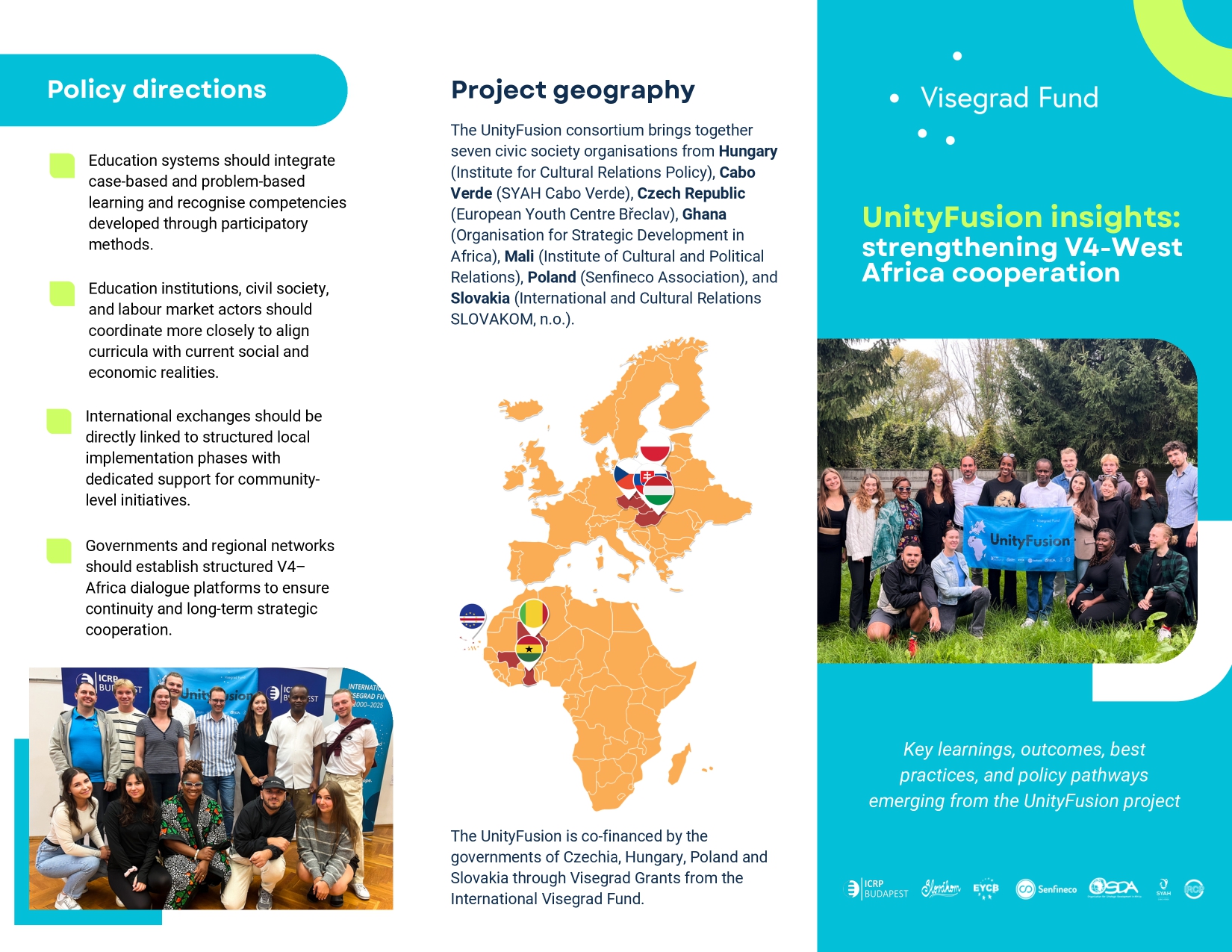
UnityFusion project aims to enhance capacity building between Visegrad countries (Hungary, Slovakia, Czech Republic, Poland) and Western Africa (Mali, Cabo Verde, Ghana), focusing on leadership development, civic engagement, and entrepreneurship. It combines local and international engagement, empowering communities through relevant educational tools. Case studies and problem-based learning techniques are utilised at the global event in Hungary, while a networking conference is held in Slovakia. The project runs from 1 June 2025 to 31 March 2026, combining online tools, in-person events, and local actions to create real social impact across two continents.
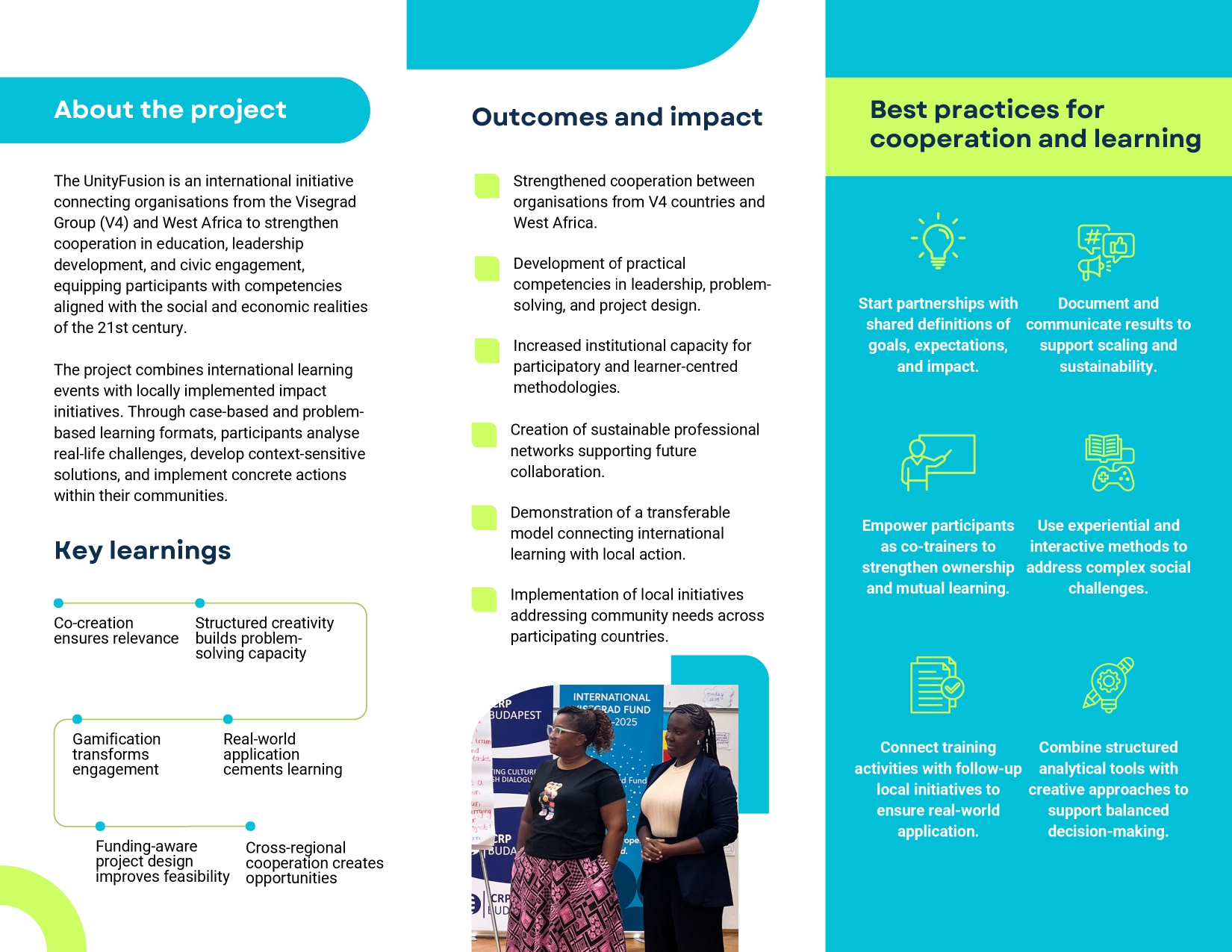
UnityFusion is designed as a collaborative platform where educational institutions and civil society organisations from V4 and Western African countries work together to address shared challenges. The project integrates formal and non-formal educational tools, with a strong emphasis on real-world application through problem-based and case-based learning methods.
A key feature of the initiative is its emphasis on co-creation: African and European trainers jointly develop and deliver content, ensuring regional relevance and mutual engagement. The project also supports the implementation of locally tailored initiatives in each partner country, allowing communities to benefit directly from the skills and ideas developed during the international activities. In addition to the practical training, UnityFusion encourages dialogue and cooperation on policy level, contributing to long-term partnerships and structured knowledge exchange.
Programme and action:
Visegrad Grant
Dates:
2025-2026
Venue:
Fonyód, Hungary - Sobotište, Slovakia
Number of participants:
280+
Participating countries:
- Cabo Verde
- Czech Republic
- Ghana
- Hungary
- Mali
- Poland
- Slovakia
Objectives
-
Establish meaningful cooperation between V4 and Western African countries.
-
Enhance hard and soft skills through formal and non-formal education.
-
Promote mutual knowledge exchange — not top-down training.
-
Support leadership development, entrepreneurship, and civic engagement.
-
Implement practical, community-based local impact initiatives.
The partnership
The project brought together seven partner organisations from Europe and Africa:
-
🇭🇺 Institute for Cultural Relations Policy (Hungary) – Coordinator
-
🇨🇻 SIDS Youth AIS Hub (Cabo Verde)
-
🇨🇿 European Youth Centre Břeclav (Czech Republic)
-
🇵🇱 Senfineco Association (Poland)
-
🇸🇰 International and Cultural Relations SLOVAKOM (Slovakia)
Each partner was selected based on strong expertise in youth empowerment, civic education, or grassroots development, and all played equal roles in design, implementation, and dissemination.
Who benefits?
UnityFusion targeted a wide range of participants:
-
21 representatives from the 7 partner organisations
-
170 participants involved in local impact initiatives
-
12 internal expert trainers (both V4 and African)
-
70+ educators, policymakers, and institutional actors
Participants were selected based on motivation, leadership potential, and ability to drive change in their communities.
Main activities
1. Case-Based Learning Summit
🗓️ 21–26 September 2025
📍 Fonyod, Hungary
A 6-day intensive event where V4 and African representatives worked in mixed teams to solve real-world challenges. African trainers lead sessions on community leadership and entrepreneurship, while V4 experts guided policy advocacy work. Outputs included:
-
Prototypes of local initiatives
-
Policy recommendations
-
Strengthened networks
The Case-Based Learning Summit brought together representatives of V4 and African partner organisations for an intensive learning experience focused on leadership, civic engagement, and entrepreneurship development. Designed around case-based learning and problem-based learning methodologies, the summit created a collaborative space where participants could exchange perspectives, analyse real-world organisational challenges, and co-create innovative solutions.
Throughout the programme, participants engaged in a dynamic series of workshops and interactive sessions exploring topics such as problem-solving methodologies, root cause analysis, stakeholder mapping, inclusive leadership in intercultural teams, systems thinking, and fundraising for local needs. A dedicated practical session on the Six Thinking Hats method enabled mixed-country teams to approach complex challenges from multiple perspectives, strengthening both analytical and collaborative capacities.
The summit also placed strong emphasis on intercultural cooperation and trust-building, incorporating team-building activities, reflection sessions, and experiential learning formats that encouraged meaningful dialogue between participants from diverse backgrounds. By combining structured learning tools with informal exchange and cultural experiences, the event fostered an environment of mutual learning and partnership development.
As a culmination of the summit, participants worked on the design of local impact initiatives, transforming identified community needs into actionable project ideas. These outputs laid the groundwork for continued collaboration and directly informed the next stage of the programme – the International Networking Conference.
2. International Networking Conference
🗓️ 26 September – 1 October 2025
📍 Sobotište, Slovakia
A high-level strategic event that built on the summit’s outcomes. It included:
-
Showcasing and refining local initiatives
-
Planning joint future projects and partnerships
-
Publication of a final brochure with key insights
Building on the outcomes of the Case-Based Learning Summit, the International Networking Conference provided a strategic platform for the participants to deepen partnerships, refine project concepts, and explore concrete pathways for long-term cooperation.
The conference combined networking, capacity-building, and strategic project development through a diverse programme of thematic sessions, workshops, and collaborative laboratories. Participants explored topics including grant selection, V4–Africa funding opportunities, project finance, and communication strategies for project visibility. These sessions equipped organisations with practical tools to strengthen their institutional capacities and scale their local impact initiatives.
A central element of the conference was the Project Lab series, where mixed teams worked intensively on defining community challenges, designing solutions, mapping partnerships and resources, and refining project pitches through structured feedback rounds. This practical process transformed ideas generated during the summit into more developed, partnership-based initiatives with clearer implementation pathways.
The conference also featured an Organisational Market and partnership-building sessions, creating dedicated spaces for participants to exchange expertise, identify complementary strengths, and establish connections for future joint initiatives. Through this collaborative approach, the event strengthened institutional links between V4 and African organisations and contributed to the development of sustainable cooperation models extending beyond the project lifecycle.
3. Local Impact Initiatives
🗓️ October 2025 – February 2026
📍 In all 7 partner countries
Each partner launched a local action tailored to their community’s needs. At least 170 people were engaged through workshops, mentorships, campaigns, and pilot projects. These initiatives turned training into action.
The Grant Selection Workshop in Bratislava brought together 25 young leaders and active citizens for a practical training session focused on strengthening skills in project development and funding acquisition. The workshop aimed to transfer knowledge gained during the UnityFusion international mobility activities and the Case-Based Learning Summit into tools that participants could use to address local societal challenges.
The session introduced participants to the fundamentals of grant searching, proposal development, and strategic project planning. Through guided discussions and interactive exercises, participants explored how international cooperation between the Visegrad region and West Africa can inspire innovative local initiatives and encourage stronger civic engagement among young people.
Participants worked in teams to simulate the process of developing and evaluating grant proposals. During the Idea to Keyword exercise, teams transformed community challenges, such as youth unemployment or civic participation, into concrete project ideas and relevant search terms for funding opportunities. In the Grant Vetting Challenge, participants analysed a fictional call for proposals and assessed whether their project ideas aligned with the donor’s priorities, mission, and selection criteria.
The workshop also included a Risk Management Brainstorming session, where participants discussed common challenges in project implementation and explored strategies to prevent them.
As a result, participants strengthened their understanding of grant selection, project planning, and impact-oriented thinking. The initiative also helped build stronger connections between youth organisations, universities, and local communities interested in developing new initiatives and planning cross-border cooperation with West Africa.
A Local Impact Initiatives training session was organised in Mali to transfer knowledge and skills gained during the UnityFusion international activities in Hungary and Slovakia to local participants. The event focused on strengthening leadership, entrepreneurship, and civic engagement among young people and community actors.
The training aimed to empower participants with practical tools that would enable them to respond to social and economic challenges within their communities. It also contributed to strengthening cooperation between the Visegrad region and West Africa by translating international learning into locally relevant educational activities.
The programme combined formal and non-formal educational approaches and was structured around three thematic modules. The first module focused on Entrepreneurship and Project Design, introducing key concepts such as the entrepreneurial mindset, idea development, market research, and strategic planning. Participants learned how to structure project ideas using tools such as the Business Model Canvas, SWOT analysis, and the marketing mix.
The second module addressed Leadership and Community Influence, presenting leadership as the ability to unite and motivate people toward a shared goal based on trust and shared values. Through practical examples and discussion, participants reflected on how leadership can support positive change within their communities.
The final module focused on Civic Engagement, where participants took part in role-playing exercises simulating community mobilisation and advocacy. These activities helped participants develop communication skills and strategies for encouraging collective action.
The training strengthened participants’ project management skills, leadership capacities, and community engagement strategies, while also creating a local network of young ambassadors committed to promoting the values and impact of the UnityFusion project.
The educational initiative “Connecting Continents” was organised as an interactive learning event aimed primarily at young people and young adults. The activity promoted intercultural dialogue and understanding between Europe and Africa through a creative and engaging educational format.
At the centre of the initiative was an educational game built around a series of interconnected puzzles and collaborative tasks. Participants worked in teams to solve challenges related to geography, culture, history, and innovation, strengthening both their knowledge and teamwork skills.
The game included several types of activities. Geographical challenges encouraged participants to identify capital cities and explore world geography, while logic-based puzzles highlighted connections between European and African cultures. Multi-sensory tasks introduced participants to musical traditions and contemporary cultural expressions, while dexterity-based challenges presented major discoveries and innovations originating from Africa.
Each stage of the game included educational explanations, ensuring that learning remained an integral part of the experience. Additional hidden clues and smaller puzzles encouraged exploration and sustained engagement.
The event concluded with a short reflection quiz and informal discussions among participants. By combining education, teamwork, and cultural exchange, the initiative successfully strengthened intercultural awareness and highlighted the importance of cooperation between continents.
An open laboratory dedicated to movement and dance exploration was organised in Ostrava, Czechia. The event provided an inclusive space where participants of different backgrounds and abilities could explore movement as a form of expression, connection, and creative reflection.
The session was designed as a shared journey into body awareness and relational movement. Participants were encouraged to discover their own physical expression while engaging with the movement of others in a supportive and respectful environment.
The laboratory was built around the principles of Contact Improvisation and Elemental Flow-work, combining guided exercises with open exploration. Through structured movement practices, participants experimented with weight-sharing, touch, spatial awareness, and creative improvisation. Movement prompts introduced by the facilitator helped anchor the experience while allowing freedom for personal interpretation.
Participants highlighted the welcoming and inclusive atmosphere of the lab, noting that the experience allowed them to move beyond habitual patterns and explore new ways of connecting through movement. The open format encouraged experimentation, creativity, and reflection.
The Leadership & Entrepreneurship Forum in Budapest gathered 20 participants and was designed as a structured knowledge-transfer and capacity-building event. Particular attention was given to exploring how lessons emerging from V4-West Africa cooperation can inspire local initiatives and strengthen cross-regional collaboration while connecting education with tangible community impact.
The programme opened with an interactive plenary session presenting key insights, tools, and approaches explored during the international activities. Special focus was placed on understanding how cross-regional cooperation between the Visegrad region and West Africa can generate new perspectives on leadership, civic engagement, and entrepreneurship, and how these perspectives can be translated into local practice.
Following the introduction, participants engaged in two thematic practice blocks. The first block, Entrepreneurial Thinking for Social Impact, introduced practical tools such as problem framing, opportunity recognition, and basic impact planning. Through facilitated group exercises, participants applied these tools to locally relevant educational and community-based challenges. The second block, Leadership for Civic Engagement and Community Development, focused on adaptive leadership, collaborative governance, and responsible decision-making in educational and civic settings.
The forum concluded with a collective dialogue reflecting on how educational actors, civil society organisations, and community leaders can contribute to strengthening cross-regional collaboration between the Visegrad region and West Africa while ensuring that educational initiatives lead to tangible and meaningful impact within local communities.
As part of the UnityFusion project, SYAH Cabo Verde organised a local dissemination and capacity-building activity on Santiago Island, bringing together 43 young participants from different communities. The event aimed to transform the knowledge gained during international mobility activities into practical tools for local youth development and civic engagement.
The session focused on sharing experiences from the international exchange and discussing how these insights could address challenges affecting young people in Cabo Verde. Particular attention was given to strengthening youth leadership, encouraging women’s participation in community life, and exploring new opportunities for civic engagement.
Using non-formal education methods, the programme combined interactive presentations, ice-breakers, energisers, role-play exercises, testimonials, and collaborative group discussions. These approaches encouraged participants to actively reflect on local issues and identify possible solutions together.
The activity created an open and participatory learning environment where young people could exchange experiences, build confidence, and develop practical ideas for community initiatives. By connecting international learning with local realities, the event strengthened youth capacity for leadership and reinforced the importance of cooperation between Europe and West Africa.
A local dissemination session was organised in Ghana to strengthen the capacity of youth organisations and emerging NGO leaders. The session brought together 20 youth leaders and community actors interested in developing sustainable community initiatives.
The training focused on practical aspects of project development and international cooperation with the Visegrad region. Participants explored key topics such as needs assessment, stakeholder mapping, fundraising strategies, and aligning project ideas with potential donors and grant opportunities.
Through presentations and interactive discussions, participants learned how to transform community challenges into structured and fundable project proposals. A simulation exercise allowed participants to design and pitch their own project ideas, applying newly introduced planning tools in practice.
The session also introduced opportunities related to V4-Africa cooperation frameworks, helping participants better understand how international partnerships can support local development initiatives.
As a result, participants strengthened their skills in project design, proposal writing, and fundraising preparation. Many expressed interest in forming working groups to continue developing project ideas and pursue international cooperation opportunities.
Publication
Dissemination and legacy
UnityFusion placed strong emphasis on ensuring that its results are shared widely and contribute to future development work. All partners engaged in multi-level dissemination using their institutional channels, websites, and social media platforms. In Africa, local media, universities, and community organisations played a central role in communicating the project’s outcomes, helping reach rural and underserved populations.
A professionally designed final brochure captured best practices, methodologies, and policy recommendations emerging from the project. This publication is available in both digital and print formats and distributed at the international networking conference in Slovakia and beyond.
Each partner also organised local knowledge-sharing events, gathering civil society actors, policymakers, educators, and youth leaders to discuss findings and build on the project’s outcomes. By offering its methods and results as open-source resources, UnityFusion encourages replication and adaptation by other organisations working in similar contexts.
Results
UnityFusion is designed to deliver a broad spectrum of results that are both strategic and community-oriented. The project fosters stronger Africa–V4 knowledge exchange, where African and European experts collaboratively develop and deliver content. This two-way engagement enriches the learning process and ensures relevance in both regions.
Participants gained enhanced leadership and entrepreneurial competencies, with the ability to tackle societal challenges using innovative tools and collaborative approaches. These skills were directly applied in the implementation of seven local impact initiatives, one in each partner country. These initiatives were designed during the project’s international events and executed locally, ensuring that knowledge transfer results in measurable community benefits.
In the longer term, UnityFusion aims to support the sustainable integration of project outcomes into the strategies of educational institutions, civil society organisations, and public agencies. The establishment of a cross-continental professional network will further extend the project’s legacy, enabling future collaboration and the development of new joint initiatives. By promoting institutional learning and building a solid foundation for Africa–V4 cooperation, UnityFusion ensures that its impact will endure well beyond the project’s formal timeline.
UnityFusion is supported by the International Visegrad Fund (IVF), a regional grant-making institution founded by the governments of Hungary, Poland, Slovakia, and the Czech Republic. The Fund promotes international cooperation and supports projects that strengthen regional ties and encourage knowledge sharing between the Visegrad countries and other parts of the world. Through its support, IVF enables initiatives like UnityFusion to connect communities, build skills, and foster meaningful collaboration across continents.